
70% Higher Productivity and 55% Faster Delivery in 4 Months
Key Results
Context
A fast-growing EU-based SaaS company building a B2B platform for enterprise clients. Over a short period, the organization scaled from 17 to nearly 40 people, with most of the team consisting of engineers and limited management or delivery structure in place.
As the company grew, the volume of work, customer demands, and internal initiatives increased rapidly, creating pressure on teams and exposing the limitations of the existing ways of working.
The Challenge
Growth started to create friction instead of momentum.
From a leadership perspective, it became increasingly difficult to understand what was actually being delivered, when, and at what cost. Despite significant investment in engineering, output did not scale proportionally.
Everything felt urgent and important. Teams were constantly busy, juggling multiple initiatives, but progress was slow and unpredictable. Deadlines slipped, priorities shifted frequently, and commitments became harder to trust.
This created increasing pressure across the organization. Teams were stretched thin, context switching became the norm, and signs of burnout started to appear. Some team members began disengaging, while others questioned the sustainability of the current pace.
At the same time, decision-making was largely reactive. Without a clear system for prioritization and trade-offs, work was often driven by urgency, assumptions, or the loudest stakeholder.
The result was a system where effort was high, but impact was inconsistent.
How We Approached It
We approached the problem at both the system and leadership level, not just within individual teams.
First, we worked with co-founders to define an improved operating model for how work should be prioritized, structured, and delivered across the organization. This included establishing decision-making principles, clarifying ownership, and aligning work with business goals.
We introduced a more structured, data-informed approach to prioritization, helping leaders make trade-offs based on impact rather than urgency.
At the execution level, we simplified how work flowed through the system. Teams reduced parallel work, focused on completing high-impact items, and adopted explicit policies for how work is started, managed, and finished.
We also introduced lightweight but actionable metrics, giving both teams and leadership real visibility into delivery performance and risk, enabling faster, evidence-based decisions.
All changes were implemented incrementally, ensuring adoption without disruption and allowing the system to evolve in a sustainable way.
Results
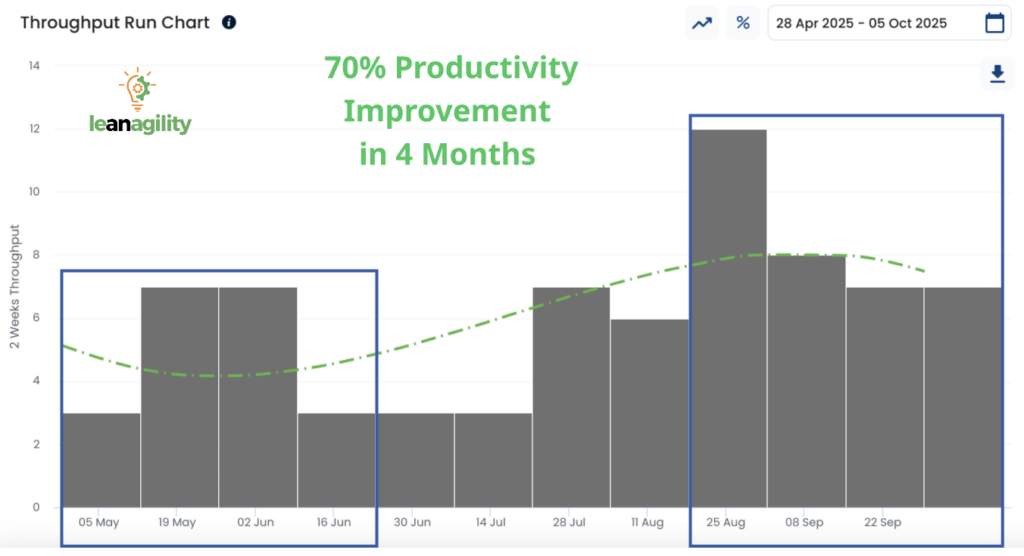
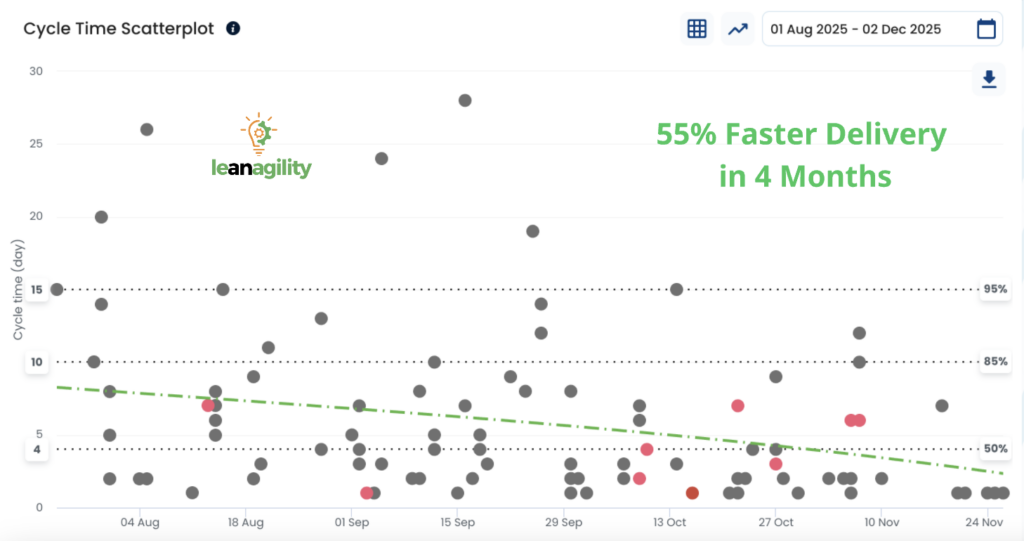
Business Impact
The organization regained control over its delivery system.
Leadership was able to make clearer, faster decisions about what to prioritize and why, ensuring that engineering effort was consistently aligned with business goals.
Teams became more focused and effective, delivering more value with less wasted effort. Delivery improved not by increasing pressure, but by improving how work was structured and managed.
This shift enabled the company to continue scaling without introducing additional complexity, while reducing operational stress across the organization.
Testimonial

How Does This Compare to Your Company?
If you’re facing similar challenges or your delivery isn’t as fast and predictable as it should be, we can have a short call to understand your setup and see if we can help.
30 minutes to see if there’s a fit